
Garage Door Won't Close: A Diagnostic Walkthrough
A step-by-step walkthrough for diagnosing a garage door that won't close, from safety sensors and obstructions to track alignment, plus the clear signs it's time to stop and call a professional.
Start With the Sensors, Not the Motor
When a garage door won't close, most homeowners assume the worst: a dying opener, a stripped gear, a motor on its last legs. After nine years running service calls across Elgin and the surrounding suburbs, I can tell you the actual cause is almost always something far simpler and far less expensive to fix, the photo-eye safety sensors mounted low on either side of the door track.
Every residential garage door opener sold in the United States since 1993 has been required to include these sensors, a rule that followed a string of child entrapment injuries and is documented by the U.S. Consumer Product Safety Commission. The sensors project an invisible infrared beam across the bottom of the doorway, a few inches off the garage floor. Break that beam, with a stray shaft of low winter sun, a cobweb, a bike leaned against the wall, a garden hose coiled in the wrong spot, and the opener reads it as an obstruction. It will either refuse to close at all, or it will start closing and reverse straight back open the instant the beam trips.
Here is the fast version of the check most of our customers can run themselves in under five minutes, before calling anyone:
- Look at both sensor units. Most have a small LED, one is usually solid, the other blinks when the beam is broken or misaligned. A dark or flickering light on either side is your first clue.
- Wipe both lenses with a dry cloth. Garage dust, cobwebs, and lawn equipment overspray build up on the lens surface and scatter the beam enough to trip a false reading.
- Check for direct sunlight. In late summer and early fall especially, low-angle sun through an open door or a nearby window can wash out the receiving sensor for a few minutes at certain times of day.
- Confirm both brackets are still bolted tight and pointing squarely at each other, not tilted up, down, or sideways from a bump by a bike, a ladder, or a car mirror.
If nudging a sensor bracket by a fraction of an inch gets the door closing again, that's your answer, and it's a genuinely common one. We walk through sensor alignment in more depth, including how to true up a bracket that's been knocked crooked, in our guide to garage door safety sensors.
Rule Out a Physical Obstruction Next
If the sensors check out clean, steady lights, aligned brackets, clear lenses, the next step is a slow visual walk of the entire door path, not just the sensor beam itself. Look at the inside of the track for anything that doesn't belong: a fallen storage box, a dropped tool, ice buildup at the base of the track after a freeze-thaw cycle, or a buildup of leaves and road salt tracked in from the driveway over the winter.
Pay attention to what's sitting directly beneath the door as it travels, too. A garden hose reel, a recycling bin rolled slightly too far into the opening, or a car parked a few inches further forward than usual can all sit inside the sensor beam's path without looking like an obvious obstruction at first glance. Walk the full width of the opening at sensor height, roughly knee-level, rather than just checking where you'd expect a problem to be.
It's also worth noting whether the door reverses at the same point every single time, or at random points. A door that stops or reverses at a consistent spot, say, always about a foot above the floor, usually points toward something mechanical, a track bind or a force-setting issue, rather than a beam obstruction, which tends to behave inconsistently depending on light and whatever happens to be sitting nearby at that moment.
Check the Track Alignment
Garage door tracks are simple in concept, two vertical rails and a curved horizontal section, but they only work within a narrow tolerance. A rail bowed even a quarter inch out of plumb can bind a roller enough to trip the opener's force sensor, which reads the added resistance as an obstruction and stops the door mid-cycle.
The most common cause we see locally isn't a manufacturing defect, it's impact and settling. A car bumper backing in slightly crooked, a bike or ladder leaned against a rail, or simple freeze-thaw movement in the garage's concrete slab over a Kane County winter can all nudge a track out of alignment by degrees too small to notice by eye but large enough to bind a roller.
With the door closed and the opener's manual release cord pulled so the motor can't engage, stand back and sight down the length of each vertical track. A straight track should show no visible bow or twist relative to the wall behind it. Run a hand along the inside face, too, feeling for rust flaking, gaps between the track and its mounting brackets, or a section that's pulled away from the wall stud entirely. Any of these point to a track problem rather than a sensor or opener issue.
Track misalignment that's mild, a slightly loose bracket, a small bow, is often a straightforward adjustment for a technician. Track that's visibly separated from the wall, badly bent, or bowed enough that a roller has popped free of the rail entirely is a different matter and shouldn't be forced back into place by hand. That's exactly the kind of repair covered under our garage door track repair service, and it's worth having someone look at it before the door gets used again.
Test the Wall Button and Remote Separately
Before assuming the whole system is at fault, isolate the controls. Press the wall-mounted button directly, then try a remote. If one works and the other doesn't, the problem is almost certainly a dead remote battery, a lost radio signal, or a wall button wiring issue, not the door or opener mechanism itself.
If neither control does anything at all, no motor hum, no light, check that the opener is actually receiving power. A tripped breaker, an unplugged cord (sometimes bumped loose during seasonal storage swaps or holiday decorating), or a dead outlet are common, unglamorous causes that get overlooked because they feel too simple to be the answer.
If the opener hums, tries to move, and then stops or reverses, that's a different signal. It means the opener has power and is receiving the command, but something downstream, sensors, an obstruction, track resistance, or force settings, is stopping it. That rules out the controls and points you back toward the mechanical checks above.
Check the Opener's Close-Limit and Force Settings
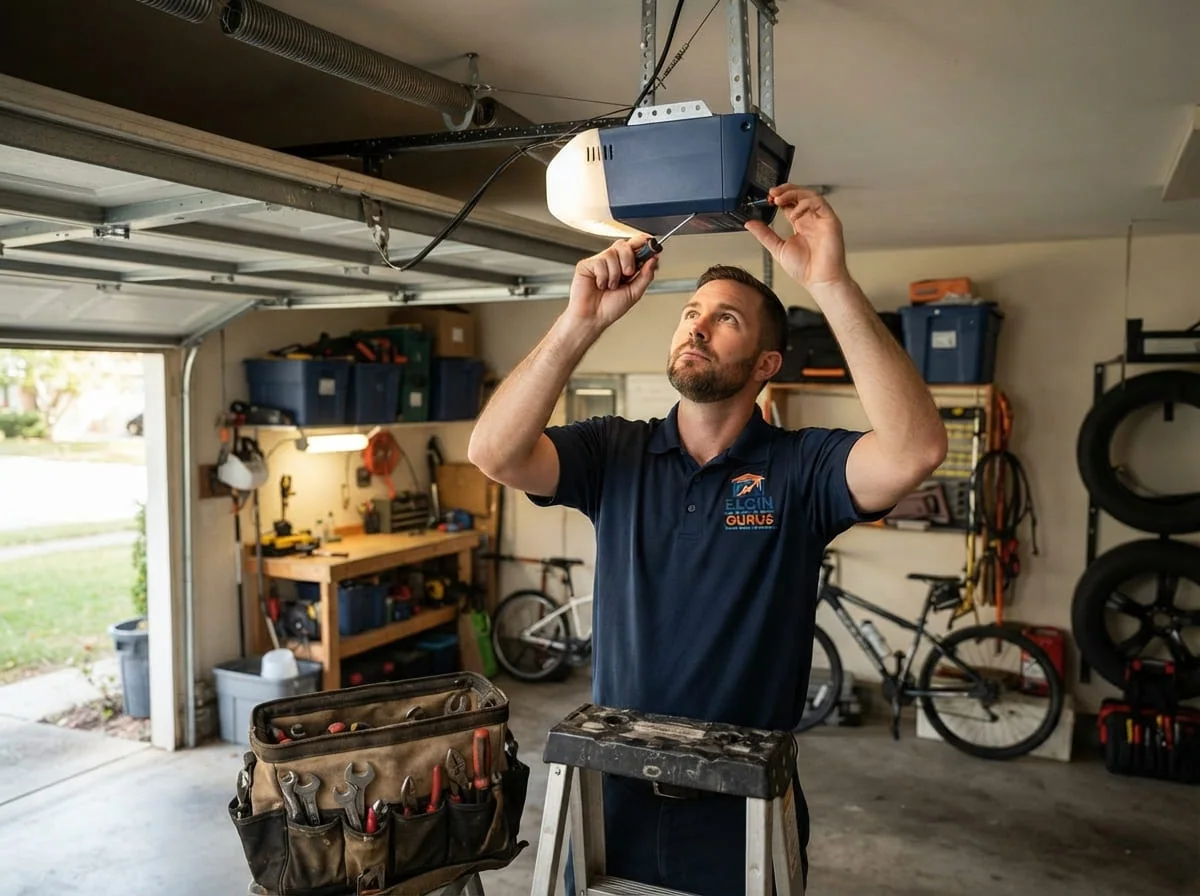
Every garage door opener has adjustable limit switches that tell the motor exactly where "fully closed" is, and force settings that tell it how much resistance to tolerate before reversing as a safety measure. If a door consistently stops a few inches short of the floor, or reverses right as it nears the ground, in exactly the same spot every time, the limit setting has likely drifted rather than something being physically wrong with the door itself.
This can happen gradually as an opener ages, or suddenly after a power surge or an accidental reset. It's a legitimate adjustment on many openers, usually a small screw or dial on the motor unit, but the exact procedure varies enough by model that getting it wrong can cause the door to close with too much force, which becomes a real safety concern if the sensors are ever slow to react.
If you're not confident telling the limit adjustment apart from the force adjustment on your specific unit, this is a reasonable point to stop and call in a technician rather than guess. Our garage door opener repair technicians recalibrate these settings routinely, and can tell you honestly whether the opener itself is nearing the end of its useful life or just needs a straightforward adjustment.
Why This Happens More Often During an Elgin Winter
Kane and Cook County winters put real stress on garage door systems in ways that are easy to overlook until a door suddenly won't close. Cold temperatures cause torsion springs to contract and lose a measure of tension, which is part of why spring failures cluster in the coldest months. The same cold makes track metal contract slightly, which can be enough to bind a roller that had plenty of clearance all summer, and it makes nylon rollers more brittle and prone to chipping.
Opener lubricant thickens in the cold as well, slowing the chain or belt drive just enough to trip a force sensor calibrated during warmer weather. Freeze-thaw cycles, which the National Weather Service Chicago office tracks as a defining feature of our regional winters, shift concrete garage slabs by fractions of an inch season to season, a slow but real contributor to track misalignment over the years.
We see this pattern reliably in Streamwood and the rest of our service area every winter: a door that closed fine in October suddenly won't close in January, and the sensors, track, and opener all test out individually "fine," because the real cause is the cumulative effect of cold on several components at once. Torsion springs themselves are rated for a specific number of open-close cycles under standards like ANSI/DASMA 102, and heavy cold-weather use tends to shorten effective spring life faster than mild-weather use.
When to Stop Troubleshooting and Call a Professional
Most of what's described above is safe for a homeowner to check, and often to fix. A few signs mean you should stop right where you are and call for help rather than keep working on the door yourself.
- A visibly broken or separated torsion spring, a gap in the coil above the door, or a door that suddenly feels far heavier than usual when lifted manually. Torsion springs are under very high tension and are not a homeowner repair.
- Frayed, kinked, or visibly damaged lift cables on either side of the door.
- A track that has pulled away from the wall, is badly bent, or has a roller off the rail entirely. The door is now structurally unstable even if the opener seems to be working.
- The door closes unevenly, one side reaching the floor well before the other, which usually points to a spring or cable problem rather than a sensor or track issue.
- The door has come fully off its track and is resting at an angle.
If you're seeing any of that, don't keep pressing the button hoping it works itself out, and don't attempt a spring or cable repair yourself. These are exactly the failures our emergency garage door repair service handles, and getting a technician out promptly matters more here than in most of the checks above, both for safety and to keep a contained repair from turning into a bigger one.
On the other hand, if everything above checks out safe, clean sensors, a clear path, a straight track, working controls, reasonable limit settings, and the door still won't close, that's a good sign the underlying issue is something a technician can diagnose quickly rather than something dangerous. We diagnose before we quote, every time, and we'll tell you plainly whether it's a small fix or something bigger. You can read more about that approach and why we built the company around it.
Quick Diagnostic Checklist
If you want the short version to run through in the garage, use this order. It moves from safest and most common toward the more serious, so you're not tempted to skip straight to worrying about springs when the answer is usually a smudged sensor lens.
- Check both sensor LEDs, wipe the lenses, confirm alignment, and rule out direct sunlight.
- Walk the full door path for obstructions, including anything sitting at sensor height.
- Sight down both vertical tracks for bowing, gaps, or separation from the wall.
- Test the wall button and a remote separately to isolate a control issue from a mechanical one.
- Note where the door stops or reverses, and whether it's consistent, which points toward limit or force settings rather than a beam obstruction.
- Stop immediately if you see a broken spring, a frayed cable, a track pulled from the wall, or a door off its track.
If you've worked through this list and the door still won't close, or you've hit one of the stop-and-call signs above, reach out. Elgin Garage Door Repair Gurus offers upfront, honest pricing and free quotes before any work begins, along with same-day appointments where possible. Call (224) 339-7333 or contact us and we'll get a technician out to look at it directly.

Marcus Reyes
Owner and lead technician at Elgin Garage Door Repair Gurus, serving Elgin, IL since 2017.
FAQs
Why does my garage door open just fine but won't close?
This is almost always the safety sensors or something crossing their beam path, not the opener motor. Check that both sensor LEDs are lit steady, wipe the lenses, and make sure nothing, including low sun, is crossing the beam a few inches off the floor. If the door closes after a small nudge to the sensor bracket, you've found the cause.
Is it safe to keep pressing the remote if the door won't close?
Repeatedly pressing the button rarely helps and adds unnecessary wear on the motor and drive gear. If the door reverses or stops in the same spot every time, work through a proper check of sensors, track, and settings instead of repeating the same command and hoping for a different result.
Can I fix a bent or misaligned garage door track myself?
A very minor bracket adjustment is sometimes reasonable, but a track that's bowed, separated from the wall, or has a roller off the rail should not be forced back into place by hand. The door can be under enough spring tension that working on the track yourself is genuinely dangerous. That's a call-a-professional situation.
How much does it cost to fix a garage door that won't close?
It depends entirely on the cause. Sensor alignment is often a five-minute fix, while a bent track or a worn opener component takes more time and parts. We provide free upfront quotes before any work begins, so you know exactly what you're paying for and why, rather than guessing at a number that doesn't apply to your situation.
How do I know if the problem is the sensors or the opener itself?
Watch where the door stops. If it won't close at all, or reverses immediately near the floor, suspect the sensors first. If it starts closing, gets partway down, and stops or reverses well above the floor in the same spot every time, that points more toward the track, force settings, or a mechanical bind rather than the sensors.
Is a garage door that won't close actually a safety issue?
It can be, especially if the underlying cause is a failing spring, a frayed cable, or a track pulling away from the wall. Those situations carry real risk from stored spring tension and a door that's no longer securely supported. If you see any of those signs, stop troubleshooting and call for service rather than continuing to test the door yourself.
Have a Garage Door Problem Right Now?
Skip the guesswork — call Elgin Garage Door Repair Gurus for a fast, honest diagnosis.